
The operational framework for Forward-Looking Property Management™
Only 6% of property owners in Sweden work strategically with maintenance. Most get stuck in a daily routine where urgent issues always take priority. The KPA methodology—Know, Plan, Act—is Planima’s operational framework that helps property owners move from insight to action, systematically and repeatedly.

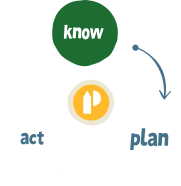
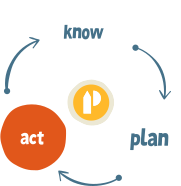
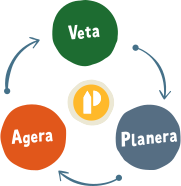
- KPA stands for Know–Plan–Act—a cyclical framework for systematic property management
- Every step is connected: better data leads to better plans, and better plans lead to better execution
- KPA works for all types of property owners—from housing cooperatives to municipalities, parishes, and industrial companies
- Planima is built around the KPA methodology and makes every step easier, faster, and more data-driven
What is the KPA methodology?
The KPA methodology is Planima’s operational framework for property management. KPA stands for Know–Plan–Act and is a cyclical process where each turn refines the result: you know more, plan better, and act more effectively with every iteration.
The methodology is the operational core of Forward-Looking Property Management™ — Planima’s broader philosophy for how modern property organizations should work. Think of KPA as the engine—Forward-Looking Property Management is the entire vehicle.
KPA is not a digital tool, but a way of working. It can be applied regardless of which system solution you use—but Planima’s platform is built specifically to support every step of the cycle.
[[divider]]
Why is a new way of working needed?
Traditional property management has long been based on experience, gut feeling, and ad-hoc interventions. That worked in a time of stable economy, fewer requirements, and lower complexity. But four factors have fundamentally changed the conditions
01.
Regulations have increased
EU taxonomy, CSRD, EPBD, K3—all impose requirements for documentation, transparency, and strategic planning. Decisions must be justified with data, not intuition.
02.
The economy is under more pressure
Inflation, rising interest rates, and increasing construction costs mean that every maintenance dollar must be used more efficiently. In Planima’s industry report "Framåt 2026," 91% of property owners state that they are regularly forced to choose between emergency and long-term maintenance – and 77% prioritize only the emergency tasks when the budget is tight.
03.
Sustainability requirements have tightened
Energy efficiency, climate adaptation, and Scope 3 reporting are no longer future concerns – they are board-level issues.
04.
Reliance on key individuals is a risk
When an experienced property manager leaves, their knowledge goes with them. Without a systematic approach, the next person starts from scratch.
Only 6% of property owners in Sweden work strategically with maintenance, while 91% are regularly forced to prioritize between urgent and long-term measures. Since reactive maintenance costs 25–30% more than planned maintenance, a systematic way of working is essential for creating predictability and reducing reliance on key individuals.
In this reality, a good plan isn't enough. You need a way of working that the entire organization can follow – regardless of who is in which role.

Truly understand the current situation
Everything starts with the right information. Not all information – but the information required for well-founded decisions.
Activities
Collect data on the property's components, condition, energy performance, and technical requirements. Identify specific goals for the property based on the organization's overall management objectives. Structure the information so that it is accessible and useful for decision-makers.
The deliverable
A clear current status and a target vision – the starting point for effective planning.
In everyday life, it shows when
Budget discussions are based on actual needs. Management and the board quickly understand the consequences of different choices. Future risks are identified in time, before they become urgent.
Create a plan that guides the business
With the current status and target vision in place, you create a plan that not only describes what needs to be done – but optimizes how it is done.
Activities
Identify which measures create the most value given your circumstances. Evaluate scenarios: what happens if we postpone the roof replacement by a year? What do we save by coordinating the facade and windows? Translate the plan into a budget and decision-making basis.
The deliverable
A plan that balances technology, economics, and sustainability – and is actively used for prioritization.
Important: Planning is about planning – not engineering. The precision should provide a basis for decisions and budgets, not for procurement and execution.
In everyday life, it shows when
The maintenance plan is actively used for prioritization. Energy measures and maintenance are coordinated instead of competing. Long-term consequences are weighed in even when short-term decisions must be made.
Execute, follow up, and learn
The third step takes the plan from document to reality. But follow-up is just as important as execution.
Activities
Translate the plan into procurement documents and schedules. Identify the right parties, obtain quotes, and select suppliers. Execute measures with ongoing follow-up. Report back actual costs and lessons learned – that information is fed back into the "Know" phase.
The deliverable
Completed measures, documented and reported. The cycle begins again – with richer data.
In everyday life, it shows when
Projects are linked directly to the long-term plan. Completed measures are returned as lessons learned. The organization gradually builds a better basis for decision-making.
Three phases:
how the KPA methodology matures in your organization
The KPA cycle is not static. The more rounds your organization completes, the stronger the methodology becomes – and the less dependent you become on external reference data.
It happens in three phases.
01.
The Foundation Phase
When you start working with the KPA methodology, you are largely dependent on industry-aggregated data and Planima's strategic framework. What does this type of building cost to maintain? How long do these components last?
Planima-priser™ – data from 15,000+ maintenance plans – gives you that calibration. It is a secure and well-founded starting point, even if you don't have your own history to lean on.
02.
The Transition Phase
With every completed measure and every reported cycle, you begin to build up your own data. Your actual costs. Your properties' components. Your portfolio's unique patterns. During the transition phase, a gradual shift occurs: industry data is still an important sounding board, but your organization's own insights begin to carry more weight in decisions.
The transition phase is divided into two steps: Alignment—where the organization synchronizes processes and begins populating the system with its own data—and Differentiation—where your view of the portfolio increasingly diverges from industry standards because it reflects your actual conditions.
03.
The Realization Phase
In the realization phase, your organization's proprietary data takes the lead. You no longer need to guess what things cost or how long components will last—you know, for your own properties, based on actual history. This is the phase where maintenance debt is systematically reduced, costs become predictable, and you can demonstrate—with concrete figures—that you are in control.
That is what most property owners are missing. And that is where the KPA methodology takes you.
[[divider]]
The Strategic Model
The KPA cycle answers the question "how?". But it needs a compass to answer "where to?". That is the role of the strategic model.
It creates the link between the organization's overall goals—financial, technical, and sustainability-related—and day-to-day management.
The strategic model in seven steps:
01.
Identify corporate goals
Linked to property management (return requirements, sustainability goals, growth plans)
02.
Formulate management goals
Concrete, measurable goals (e.g., "reduce total maintenance costs by 10% by 2030")
03.
Identify stakeholders
Tenants, board, bank, politicians, suppliers
04.
Establish frameworks
Internal (budget, strategic priorities) and external (legal requirements, climate risks, market trends)
05.
Formulate strategy
How will the goals be achieved given the frameworks and challenges?
06.
Translate into prioritization logic
What criteria determine which measures are prioritized?
07.
Implement the working method
Throughout the entire organization
Strategic work runs in parallel with the KPA cycle – not as a one-off effort, but as an ongoing process that is refined over time.
The strategy sets the direction. KPA takes you there – time and time again.
[[divider]]
The effects of working according to KPA
Organizations that work systematically according to the KPA methodology experience three clear effects: predictability, lower costs, and sustainability gains.
01.
Predictability
Working with KPA means having complete control over technical condition and financial requirements – both short and long term. You avoid surprises and unfounded decisions.
It is built on:
- A strategic framework that provides management, the board, and the property management team with a shared view of the property portfolio's needs – based on industry-unique expertise and data-driven insights
- Expert support, guides, and best practices from Planima, based on thousands of completed maintenance processes
- Planima-priser™ – data from 15,000+ maintenance plans – which provides well-founded assessments of costs and maintenance requirements
- Planima's market-leading planning tool, which structures and provides access to information in real time
Planima's industry report "Framåt 2026" shows that among property owners who work with an established management strategy, over 80% feel well-equipped for future requirements. Among those who are reactive: barely 20%.
02.
Lower costs
KPA enables the right action at the right time, better coordination, and lower total costs. Reactive maintenance costs on average 25–30% more than planned, proactive maintenance.
It is achieved through:
- Clear strategic priorities for what needs to be done – and what can wait. You reduce emergency interventions and costly misinvestments
- The right expertise and resources at the right time, with reduced administrative costs
- Actual costs and action levels based on thousands of real-world maintenance plans via Planima-priser™
- A planning tool with support for budgeting, coordination, and continuously updated price lists
03.
Sustainability gains
Energy, climate, and social values are naturally integrated into every decision – not as a separate track, but as part of the planning cycle.
It is made possible by:
- Planima's leading framework for maintenance strategy, which includes the sustainability perspective at the core of the KPA cycle
- Concrete support in choosing measures that are sustainable over time – technically, economically, and environmentally
- Data from thousands of properties providing powerful insights into climate impact, energy performance, and the effectiveness of measures.
- Planima’s planning tool, which visualizes climate impact and enables systematic work with CO₂ Scope 3, energy savings, and climate risks.
From blank page to actionable maintenance plan – in no time.
Predictability. Sustainability gains. Better decisions. More profitable
property management. That is what the KPA methodology combined with Planima's
platform delivers. Our vision is simple: zero waiting, zero
guesswork, zero excuses.
Planima's zero vision
[[divider]]
KPA for your organization
The KPA methodology is scalable and flexible. The principles apply regardless of the type of property owner you are—what differs is the application.
Public Housing
Public housing companies often manage large portfolios with requirements for social sustainability and municipal transparency. KPA helps structure maintenance work and clearly communicate needs to the municipal council and board. With a common management structure built on KPA, dependency on individual personnel is reduced, and reporting to the owner is simplified.
Municipalities
Municipalities manage a wide range of properties—schools, nursing homes, sports halls, and office spaces—often with limited resources and political oversight. KPA creates a common management language and data-driven documentation for the budget process. With Planima’s data from thousands of similar municipal properties, priorities become better-founded and easier to explain.
Private Real Estate Companies
Private players manage properties with a focus on return requirements and investor reporting. KPA enables the optimization of maintenance plans against financial goals and provides clear owner reports. Reactive maintenance erodes profitability—the KPA methodology is the operational tool for systematically minimizing the unplanned costs that eat into margins.
Parishes and congregations
The Church of Sweden’s property portfolio often includes culturally historic buildings with high and difficult-to-estimate maintenance costs. The KPA methodology provides a structured process that holds up even in the complex decision-making environments that characterize church organizations—where technical needs, cultural heritage requirements, and democratic consensus must be weighed against each other.
Logistics and Industrial Companies
Logistics, industrial, and other companies that own properties without having property management as their core business often lack internal expertise for maintenance budgeting. KPA provides a clear process to follow—without requiring in-depth internal property expertise. With Planima’s platform and data from thousands of properties, these organizations can make well-founded decisions and avoid the costly reactive outcomes that too often plague those who do not plan systematically.
Housing Cooperatives (BRF)
A housing cooperative does not need a large portfolio to benefit from KPA. An association with a single building can use the framework to create a well-founded maintenance plan, communicate clearly with members, and manage the connection to annual fees. With Planima’s platform, even a small housing cooperative can make data-driven decisions and avoid the sudden fee increases that always put the board’s credibility at risk.
Private property ownersMunicipalities & Public HousingManagers & ConsultantsHousing CooperativesChurchesLogistics & Industrial Companies
[[divider]]
Get started with KPA
You don’t need a perfect organization or complete data to get started. KPA is designed to be implemented in stages.
01.
Start with one property
Choose a pilot property that represents a common building type in your portfolio. Complete a full cycle: collect data, create a plan, implement a measure, and follow up.
02.
Evaluate and adjust
What worked? What took time? What data was missing? Adjust the process based on your experience before scaling up.
03.
Create a maintenance team
KPA works best with clear roles: a maintenance manager who owns the big picture, project managers who drive daily operations, and consultant support when needed. Appoint at least two "power users" to reduce dependency on specific individuals.
04.
Secure organizational buy-in
KPA is not just a tool for the technical manager. Involve finance, management, operations, and sustainability in the annual cycle. The more people who share the same vision, the stronger the decisions will be.
05.
Use the right platform
KPA is designed to be run on the Planima maintenance platform – but the principles apply regardless of the tool. Planima's platform makes every step easier, faster, and more data-driven.
[[divider]]
Next steps:
Start working according to the KPA methodology
Planima provides your organization with everything needed to implement the KPA methodology, supported by data, expertise, and market-leading technology:
01.
Strategy
Planima’s framework for Forward-Looking Property Management™ provides you with structure and direction – regardless of portfolio size or organizational structure
02.
Consulting
Our experts support you in implementing the KPA methodology and building a maintenance strategy tailored to your organization
03.
Data
Planima Prices™ – based on data from 25,000+ maintenance plans – provide well-founded cost estimates and action documentation
04.
Planning tool
Planima’s maintenance platform is built around the KPA methodology and supports every step from data collection and planning to execution and follow-up
Whether you want to dive deeper into industry insights, get started with digital inventory, or see how Planima can support your organization, there is a natural path forward.
Book a demoIndustry Insights - Forward 2026See the planning tool
FAQ
Frequently asked questions about the KPA methodology
VPA integrates the sustainability perspective into the core of the planning cycle. In the Plan phase, energy measures and climate adaptation are evaluated as a natural part of maintenance optimization. Planima's platform specifically supports work on Scope 3 CO₂ emissions, energy savings and climate risks.
Yes. The Church of Sweden's property portfolio – often with historic buildings and complex decision-making processes – is well suited to the VPA method. The framework helps structure maintenance work and communicate needs clearly within the democratic bodies that govern church organizations.
The principles can be applied regardless of tools. But Planima's platform is built around the VPA method and makes every step – data collection, planning, follow-up – significantly simpler, faster and more data-driven. Working with VPA in Planima also gives you access to industry-aggregated data, which is important for setting clear benchmarks at the start of the work.
The VPA method is the operational core. Framåtriktad Fastighetsförvaltning™ (forward-looking property management) is the broader concept that includes both the VPA cycle and the strategic model. Think of it this way: VPA is the engine – Framåtriktad Fastighetsförvaltning is the whole vehicle.
Conventional maintenance planning often focuses on producing a document. VPA builds a way of working: a cyclical process where data collection, planning and execution are connected and improve with every cycle. The result isn't just a better plan – it's a better organization.
VPA stands for Veta–Planera–Agera (Know–Plan–Act). It's a cyclical operational framework for property management, developed by Planima as the operational core of Framåtriktad Fastighetsförvaltning™ (forward-looking property management).
No. The principles apply regardless of portfolio size. A housing cooperative with one building can use VPA just as well as a municipality with 300 properties, a parish with historic buildings or an industrial company with a handful of logistics properties. The scale differs, but the structure is the same.