
How the Västerås pastorate does maintenance planning for one of the country’s most complex church portfolios.

Challenge
Complex facilities – and a system that couldn’t keep up
The Västerås pastorate is one of the largest in the country. The portfolio comprises 36–37 management sites within the boundaries of Västerås Municipality – from the city center out to the countryside. A typical site includes a medieval church, a churchyard, a bell tower, a mortuary chapel, and outbuildings – and sometimes also a former rectory converted into a parish hall.
But it’s not the size and breadth that make the portfolio unique. It’s the complexity.
Three of the pastorate’s more modern city churches, built in the 1960s–70s, are also designated as protected under the Historic Environment Act – with the same requirements that apply to the medieval churches. This means that design and planning times are longer and that renovation work can cost significantly more than on an ordinary site.
“The legislation is largely adapted to old churches, castles, and Visby Ringmur. And we have three churches from the 1960s–70s that are subject to exactly the same rules. That’s a challenge.”
Fredrik Lindblom, property manager and building engineer, Västerås pastorate
On top of this comes the Church of Sweden’s special budget structure. Since the church was separated from the state in 2000, two parallel economies live side by side at every site: the burial operations – funded by the state – and the parish activities, which are funded by the church’s own members.
At one and the same site, the church building, bell tower, and parish hall can belong to one budget – and the churchyard and outbuildings to the other. This creates a need to track and separate costs down to the measure level.
The system the pastorate used before had long gone without any significant updates and was cumbersome in its structure. Building reports required both time and manual work, and the ability to coordinate measures across the entire portfolio was in practice missing.
“It felt like working in something that was last up to date in the Windows 98 era.”
Fredrik Lindblom
Solution
Planima’s flexibility met the churches’ requirements
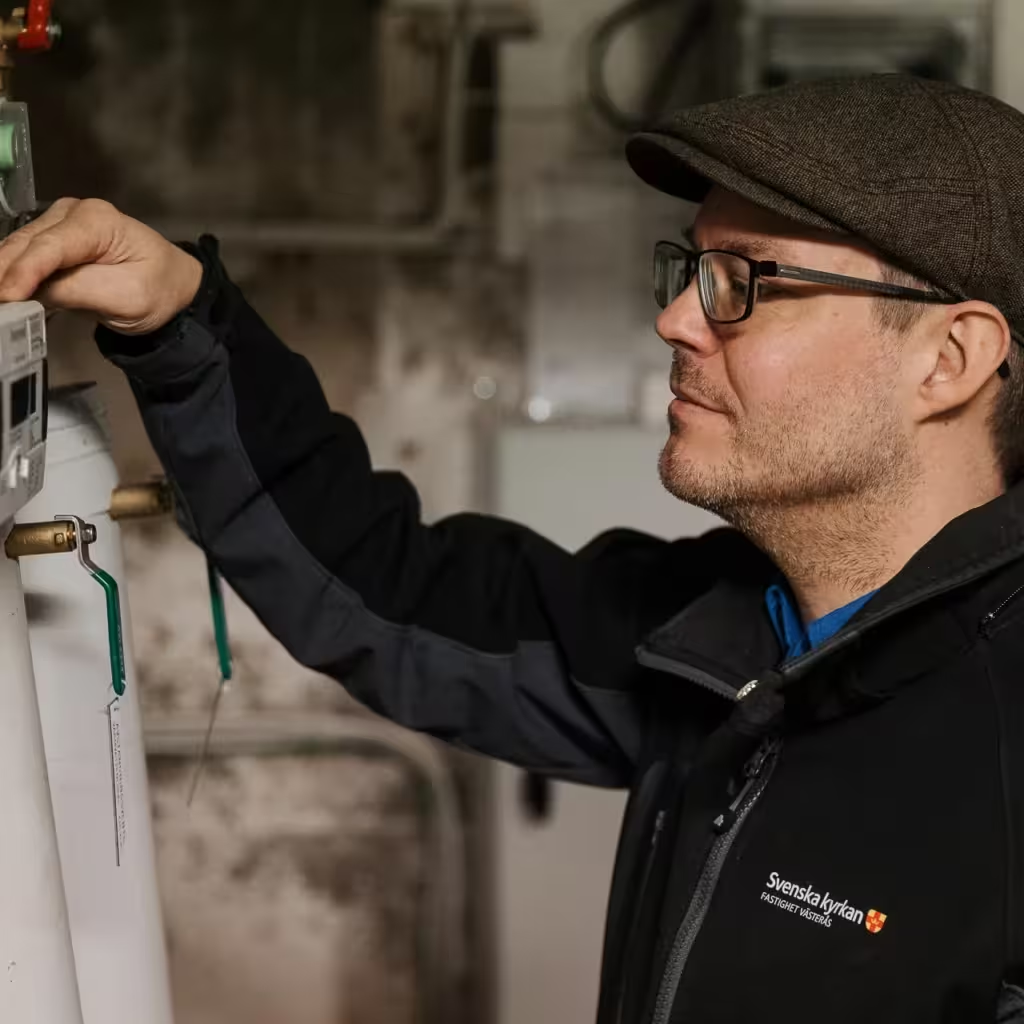
Fredrik Lindblom has worked with maintenance planning for more than twenty years – initially as a consultant, but for the past fifteen years at the Västerås pastorate. He knows what a good system should be able to handle, and he knows what the old one couldn’t.
When the Västerås pastorate decided to start working in Planima, he therefore quickly realized that this created the conditions for working in a new – and more efficient – way. So he made a clear decision early on: no migration of old data.
Instead, he went through each site from scratch – an opportunity to build a new structure that actually reflected how the Västerås pastorate works.
The first thing he built was a price list adapted to the facilities in the portfolio. Churches have a completely different cost picture than ordinary buildings – a roof replacement on a protected medieval church costs several million SEK, and the design and planning alone can cost three times more than on an ordinary site.
By using Planima’s built-in price list – Planima-priser™ – for “ordinary” measures, but using the option to create custom measure prices for the more church-specific ones, Fredrik built a pricing basis that reflects the actual cost levels in the pastorate’s portfolio.
Created specific categorization and tags
The next challenge was categorization. Initially, about fifteen categories were created – which turned out to be too many to produce clear reports and presentations. Fredrik trimmed the category structure down to six: grounds & site, building exterior, building interior, electrical installations, plumbing and HVAC installations, and other installations.
For the day-to-day planning work, he created further granularity by using Planima’s “Locations” feature as subcategories, combined with tags –that is, labels on individual measures so they can be filtered in the coordination view in Planima.
The budget split is handled with the tags FV (parish activities) and BV (burial operations) on each measure. Measures that qualify for KAE grants (church heritage compensation) are tagged separately. That way, Fredrik can always filter out exactly what he needs – whether it’s for budget reporting, grant applications, or coordination.
“It was the ability to tag those odd things and easily filter them out that got me hooked on Planima from the start. For example, I can list all tarred details, all fire alarm control panels, all churches with electrified chandeliers – across the entire portfolio – with a couple of clicks.”
Fredrik Lindblom
Results
A grip on the entire portfolio – and coordination savings that count
With the tag system in place and the portfolio built up in Planima, the benefits became apparent relatively quickly. But perhaps the most important value doesn’t lie in the overview itself – it lies in what it makes possible.
With 20 geographically dispersed churches, the ability to cluster measures – rather than planning site by site – is crucial to keeping costs down. Planima’s coordination view makes it possible to filter out similar measures across the entire portfolio and plan them together.
Fredrik highlights a concrete example: Haraker Church has a large sheet metal roof that needs to be painted within a couple of years. On the way there, you pass Romfortuna Church, which has a small burial chapel with a sheet metal roof that also needs painting. Separately, painting the burial chapel roof could mean a procurement worth 100,000 SEK. But the cost would drop considerably if both projects can be procured at the same time.
“If I combine it into a joint procurement, the burial chapel practically comes along for the ride. It doesn’t require scaffolding, since they do it from a lift. Separately, it costs 100,000 SEK. But bundled into the package, almost nothing. And I can easily see coordination opportunities like that in Planima.”
Fredrik Lindblom
The same logic applies when Fredrik plans the replacement of intruder alarms and access control systems across the whole church portfolio – clustered geographically, three churches a year, to minimize costs and administrative burden. And for the most popular summer churches, fully booked for weddings, Fredrik plans the scaffolding two years in advance.
“Everyone wants nice wedding photos with churches without scaffolding, so you have to think ahead and prepare everyone involved for what’s in the plan.”
Fredrik Lindblom
What Fredrik describes is Know–Plan–Act in practice: full knowledge of what the portfolio contains, coordinated planning across the entire pastorate, and the ability to act efficiently when the time comes – whether it’s a sheet metal roof on a burial chapel or replacing intruder alarms in twenty churches.
Happy to recommend Planima to others – and to suggest how the platform can evolve
Today, Fredrik is one of the most trusted voices when other pastorates and parishes are considering taking the step and getting started with Planima. He is happy to talk with colleagues and welcomes visits from others who want to see how he works in practice.
“I’ve recommended it so often that I almost have to add a disclaimer that I’m not paid by Planima’s marketing department. But I genuinely think it’s a good platform. And I want to help others get tools that work.”
Fredrik Lindblom
Fredrik is also good at spotting development opportunities in Planima’s tool and actively contributes suggestions for functionality and features that could make everyday work even easier for him and other property managers within the church.
His advice to skeptics is straightforward: “For anyone with more than five churches in their portfolio, using Planima should be a no-brainer. They’ll be able to see the value almost immediately – if nothing else in the form of overview and coordination opportunities.”
From 17th-century copper sheeting to modern access control systems – the Västerås pastorate manages a portfolio that requires a completely different kind of planning than most. With Planima, they have the tools to do it proactively, in a coordinated way, and with their eyes on the future. That’s Framåtriktad fastighetsförvaltning.